



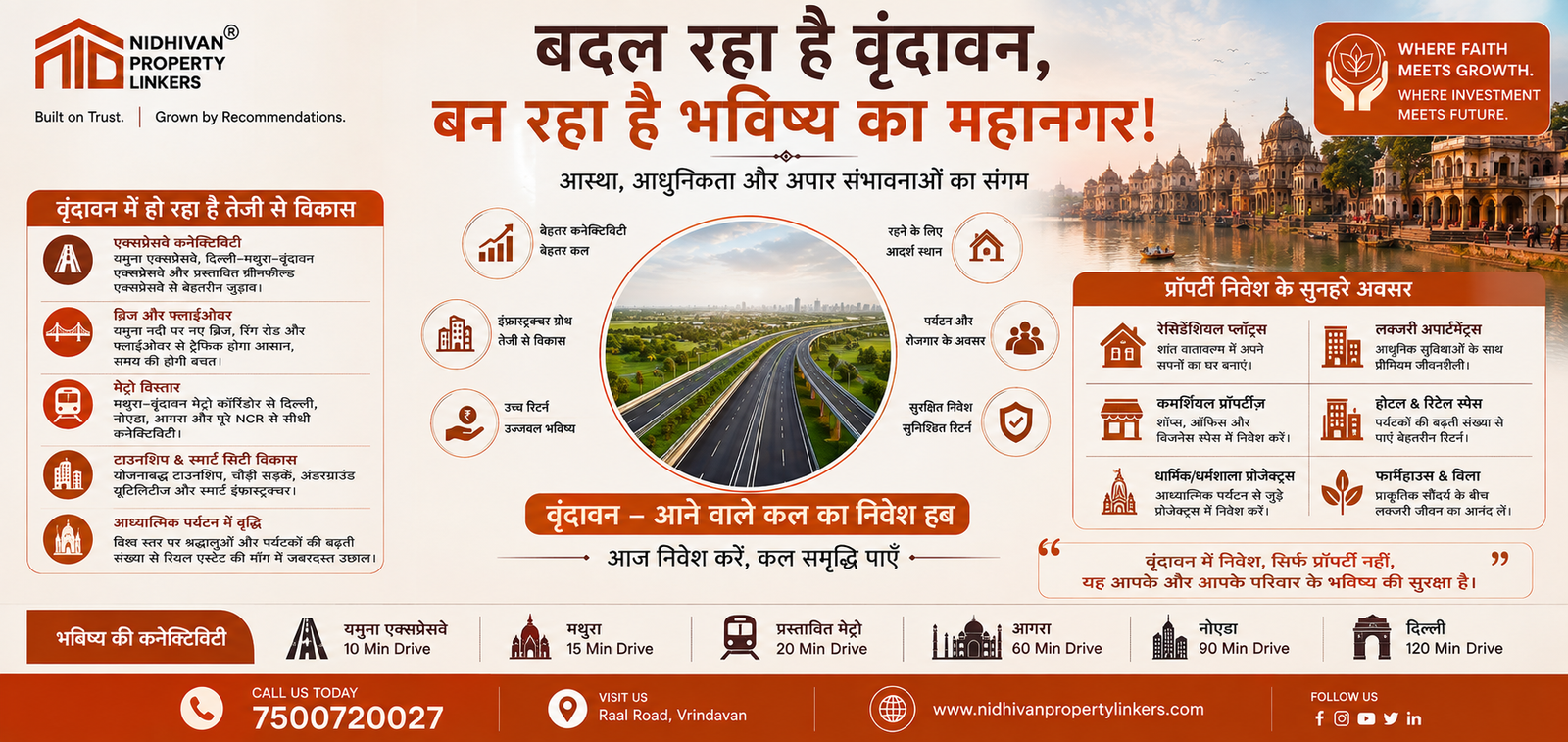
Explore Vrindavan’s 2026 development: Yamuna Expressway connectivity, Jewar Airport, roads, corridors, bridges, tourism infrastructure and property investment opportunities.
Vrindavan is entering a new phase of development. Traditionally known as one of India’s most important spiritual destinations, the city is increasingly being supported by wider road connectivity, tourism infrastructure, pilgrimage-area redevelopment, regional highway projects and improved access to major transportation networks.
For property investors, the important question is no longer simply “Is Vrindavan a religious destination?” The more relevant question is how infrastructure, tourism, connectivity and urban development could influence the long-term demand for residential, commercial, hospitality and second-home properties.
Several developments around Mathura-Vrindavan and the wider Braj region indicate that the area’s infrastructure story is becoming considerably broader than temple tourism alone.
1. Vrindavan Is Moving Towards a Larger Regional Development Ecosystem
The development story of Vrindavan cannot be viewed in isolation.
Vrindavan is part of the larger Braj region, which includes Mathura, Govardhan, Barsana, Gokul and other important religious and cultural destinations.
In 2025, the Uttar Pradesh government announced a proposed ₹30,000-crore master plan for the development of the Braj region, with the stated objective of transforming the region into a major national and international spiritual and cultural destination.
The announcement is significant because it indicates that development is being considered at a regional level, rather than through isolated projects within Vrindavan.
For real estate, regional planning can matter because roads, tourism facilities, commercial activity and public infrastructure in neighbouring destinations can influence the overall movement of people and businesses.
2. Yamuna Expressway Is One of Vrindavan’s Most Important Connectivity Advantages
The Yamuna Expressway is an established six-lane, access-controlled expressway connecting Noida and Agra over approximately 165 km. It has been operational since 2012.
For Vrindavan, its importance comes from the connection between the expressway and the Mathura-Vrindavan area.
The district administration has also issued land-acquisition notices related to a proposed four-lane road from the Yamuna Expressway towards Vrindavan/Pagal Baba Temple.
This is particularly relevant because better road access can:
- Reduce dependence on smaller local roads
- Improve access from the expressway
- Support tourist movement
- Improve accessibility for second-home buyers
- Support hospitality and commercial development
- Increase the attractiveness of locations along emerging connectivity corridors
Important distinction
The four-lane Yamuna Expressway-to-Vrindavan/Pagal Baba connection should be described as a development/land-acquisition project, not as an already completed road.
3. Noida International Airport at Jewar Has Changed the Regional Connectivity Story
One of the biggest developments for the wider region is the Noida International Airport at Jewar.
Phase I of the airport was inaugurated on 28 March 2026. The project represents a major addition to the aviation infrastructure of western Uttar Pradesh. The first phase was developed with an investment of approximately ₹11,200 crore.
The airport’s first phase includes a terminal designed to handle more than 12 million passengers annually, along with a 3,900-metre runway and cargo infrastructure.
The airport is particularly important for Mathura-Vrindavan because the Prime Minister specifically noted that the airport would benefit districts including Mathura, Agra, Aligarh, Ghaziabad and Faridabad.
Why this matters to Vrindavan
Improved airport connectivity can potentially strengthen:
Domestic tourism → International tourism → Hospitality demand → Longer stays → Commercial activity → Real estate demand
It is therefore reasonable to consider Jewar Airport as an important regional infrastructure catalyst for the Mathura-Vrindavan belt.
However, property investors should evaluate the actual road route, travel time and accessibility of an individual property rather than relying only on the headline “near Jewar Airport.”
4. Yamuna Expressway + Jewar Airport Creates a Stronger Connectivity Network
The combination of existing expressway infrastructure and the newly inaugurated airport is more important than either project individually.
The broader connectivity network now includes:
Delhi-NCR → Noida/Greater Noida → Yamuna Expressway → Jewar Airport / Mathura region → Vrindavan → Agra
This creates a larger movement corridor for:
- Pilgrims
- Tourists
- Weekend visitors
- Second-home buyers
- Hospitality businesses
- Commercial operators
- Investors
- NRIs and overseas visitors
This does not automatically mean every property in Vrindavan will appreciate, but locations with better access to major roads and established urban infrastructure can become more attractive as the regional network develops.
5. New Roads and Road Widening Are Changing Local Mobility
Infrastructure development is not limited to expressways.
The Mathura district administration has recorded multiple road-related land-acquisition and development activities, including:
- Yamuna Expressway to Vrindavan/Pagal Baba Temple four-lane road
- Govardhan Parikrama Marg service-road development
- Braj Chaurasi Kos Parikrama Marg-related land acquisition
- Road widening projects
- Six-lane Kosikalan–Chhata-related land acquisition
- Mathura-Vrindavan municipal road improvement initiatives
These government records demonstrate that road infrastructure is an active component of the region’s development programme.
The district administration also issued notices under the Chief Minister’s Green Road Infrastructure Development Scheme for Mathura-Vrindavan, including Govind Nagar road development.
6. Govardhan Parikrama Infrastructure Is Also Being Strengthened
The development story extends beyond central Vrindavan.
The government has undertaken land-acquisition processes connected with the Govardhan Parikrama Marg and associated service roads.
Records from the Mathura district administration show awards and land-acquisition activity during 2025 involving sections around Govardhan Parikrama Marg, including Radha Kund and service-road locations.
This matters because Govardhan is an important component of the broader Braj pilgrimage circuit.
Better infrastructure around the pilgrimage network can potentially distribute tourism and commercial activity across a larger geographical area instead of concentrating it only in the traditional temple zones of Vrindavan.
7. Banke Bihari Corridor Is One of the Most Important Urban-Religious Projects
The Banke Bihari Corridor has been proposed to improve the pilgrimage experience around the Banke Bihari Temple.
The earlier project proposal involved approximately five acres of land and a reported project cost of ₹262 crore, with facilities intended to improve pedestrian movement and accommodate large numbers of devotees.
The project has also been the subject of legal proceedings and changes in the proposed funding/development framework, so it is important for property content to describe it as a planned/redevelopment initiative, rather than suggesting that the corridor is already complete.
For Vrindavan, the importance of such a project goes beyond the temple itself.
Improved pilgrimage infrastructure can influence:
- Pedestrian accessibility
- Visitor management
- Commercial activity
- Hospitality demand
- Retail
- Food and beverage businesses
- Short-stay accommodation
- Local transportation
8. Krishna Ki Pauri and Yamuna Riverfront Development
Another noteworthy proposal is Krishna Ki Pauri, a planned Yamuna riverfront development near the Banke Bihari corridor area.
Recent reporting states that the Uttar Pradesh government approved a project estimated at ₹100 crore, aimed at improving the Yamuna ghats and pilgrimage experience. The proposal includes riverfront improvements and a planned Signature Bridge as part of the wider access and visual-development concept.
This type of riverfront development could add another dimension to Vrindavan’s tourism economy by connecting:
Temple tourism + Yamuna riverfront + heritage + hospitality + leisure
Again, investors should distinguish between approved/proposed infrastructure and completed infrastructure when evaluating property.
9. Railway Infrastructure Is Also Being Modernised
Roads and airports are only one part of the connectivity story.
Indian Railways’ Amrit Bharat Station Scheme is focused on modernising railway stations through improvements such as:
- Better station access
- Circulating areas
- Passenger facilities
- Foot overbridges/subways
- Lifts and escalators
- Parking
- Landscaping
- Multimodal integration
- Improved passenger information systems
The national programme has identified 1,337 railway stations for redevelopment, with works progressing across the country.
For the Mathura-Vrindavan tourism ecosystem, railway modernisation is important because rail remains one of the principal modes through which pilgrims and tourists reach the region.
10. Tourism Is the Foundation of Vrindavan’s Real Estate Demand
Infrastructure matters because people create economic activity.
Vrindavan already has an extraordinary tourism advantage because of its association with Lord Krishna, Banke Bihari Temple, Prem Mandir, ISKCON and the wider Braj pilgrimage circuit.
A study supported by the Uttar Pradesh tourism department and conducted by the Entrepreneurship Development Institute of India estimated that Mathura-Vrindavan received around 7.9 crore tourist visits in 2023, including both same-day visitors and overnight visitors.
The study estimated tourist spending at approximately ₹15,380 crore and projected substantial growth in visitor numbers and economic activity by 2030.
This is an important distinction:
Vrindavan’s property demand is not based only on population growth; it is also connected to the movement of pilgrims, tourists, second-home buyers, hospitality operators and businesses.
11. What Does This Mean for Property Investment in Vrindavan?
The infrastructure story creates several potential property segments.
Residential Plots
Residential plots can appeal to buyers looking for:
- A future home
- Second homes
- Retirement residences
- Family properties
- Long-term land investment
Locations with established road access and proximity to important destinations can have stronger practical appeal.
Apartments
Apartments may appeal to:
- Families
- Senior citizens
- Second-home buyers
- Devotees
- Investors seeking managed residential communities
Projects offering security, amenities, parking and convenient access can be particularly relevant to this segment.
Villas and Second Homes
Vrindavan’s spiritual environment creates a distinctive second-home market.
A buyer may not necessarily purchase a property purely for conventional residential purposes.
The motivation could be:
Spiritual living + family use + retirement + weekend stays + long-term asset ownership.
Commercial Property
Commercial property can benefit from the visitor economy.
Potential categories include:
- Retail shops
- Food outlets
- Cafés
- Local services
- Offices
- Showrooms
- Small commercial units
However, commercial property should be evaluated based on actual footfall, frontage, access, parking, surrounding development and legal use, rather than simply proximity to a temple.
Hospitality Property
The tourism ecosystem naturally creates demand for:
- Hotels
- Boutique hotels
- Guest houses
- Serviced accommodation
- Homestays
- Short-stay residences
The long-term opportunity depends heavily on occupancy, seasonality, competition and the quality of tourism infrastructure.
12. Which Locations Should Investors Watch?
Instead of saying that one particular sector will definitely outperform, investors should evaluate location characteristics.
Chhatikara Road
Important because of its connection to major tourism and road routes.
Sunrakh Bangar
An emerging belt where investors should carefully examine actual infrastructure, approved development and surrounding projects.
Parikrama Marg
Potentially relevant for hospitality, religious tourism and visitor-oriented businesses.
Rukmani Vihar
An established residential and hospitality-oriented area within the Vrindavan ecosystem.
Bhuteshwar / Mathura Side
Useful for investors looking at the broader Mathura-Vrindavan urban market rather than only central Vrindavan.
Yamuna Expressway-Connected Areas
These deserve particular attention as connectivity infrastructure develops, but investors should verify the exact access road, land-use permissions and development status of each project.
13. Why Infrastructure Can Influence Property Values
Infrastructure does not guarantee appreciation.
But historically, major infrastructure can influence property markets through several channels:
1. Accessibility
Better roads make a location easier to reach.
2. Time Saving
Reduced travel friction can increase the attractiveness of second homes and weekend destinations.
3. Commercial Activity
Better connectivity can encourage businesses, hotels and retail operators.
4. Tourism
Improved access can increase the practical capacity of a destination to accommodate visitors.
5. Employment
Large infrastructure and tourism ecosystems can create additional employment and service demand.
6. Urbanisation
As infrastructure improves, surrounding areas may gradually attract residential and commercial development.
14. But Investors Should Not Buy Property Only Because of an Upcoming Project
This is perhaps the most important point for a serious Vrindavan property investor.
A proposed road, bridge, airport connection or corridor should not be the only reason to buy land.
Before investing, verify:
- RERA registration, wherever applicable
- Title and ownership
- Land-use status
- Approved layout
- Development authority approvals
- Road access
- Existing physical infrastructure
- Registry eligibility
- Encumbrances
- Electricity and water availability
- Drainage
- Actual distance from major roads
- Developer’s track record
- Possession timeline
- Whether the advertised infrastructure is operational, under construction or merely proposed
“Near upcoming infrastructure” and “directly connected to operational infrastructure” are two very different claims.
15. Vrindavan’s Future Could Be More Than Religious Tourism
The bigger opportunity is the potential evolution of Vrindavan into a multi-purpose spiritual, tourism and lifestyle destination.
The emerging ecosystem could include:
Pilgrimage
↓
Tourism
↓
Hotels & Hospitality
↓
Retail & Commercial Activity
↓
Second Homes
↓
Residential Development
↓
Infrastructure Investment
↓
Long-Term Real Estate Demand
This is why Vrindavan’s development story deserves to be viewed over a 5–10 year horizon, rather than through short-term property-price speculation.
Vrindavan 2026: The Bigger Picture
Vrindavan is not becoming important because of one road, one airport or one corridor.
Its transformation is being shaped by multiple infrastructure layers developing around the same regional ecosystem.
The Yamuna Expressway provides established high-speed road connectivity. The Noida International Airport at Jewar has added a new aviation gateway for western Uttar Pradesh. Government records show continuing road and land-acquisition activity around Vrindavan and the wider Braj region. Pilgrimage infrastructure such as the Banke Bihari Corridor and Krishna Ki Pauri is intended to improve visitor management and the religious tourism experience. At the regional level, the proposed ₹30,000-crore Braj development plan indicates an ambitious vision for Mathura, Vrindavan and surrounding pilgrimage destinations.
For real estate investors, the opportunity is therefore not simply “buy property in Vrindavan.”
The smarter approach is:
Identify the right location, understand the infrastructure pipeline, verify the legal status and evaluate the property on fundamentals—not promises.
Key Infrastructure Snapshot
| Development | Status / Relevance |
|---|---|
| Yamuna Expressway | Operational |
| Noida International Airport, Jewar | Phase I inaugurated March 2026 |
| Yamuna Expressway–Vrindavan/Pagal Baba Temple road | Land acquisition/development activity recorded |
| Govardhan Parikrama Marg service roads | Land acquisition/development activity |
| Banke Bihari Corridor | Planned/redevelopment initiative; status subject to implementation |
| Krishna Ki Pauri | Approved/planned riverfront project |
| Signature Bridge concept | Part of proposed Krishna Ki Pauri development |
| Mathura-Vrindavan metro | Do not present as operational; verify any future proposal before publishing |
| ₹30,000-crore Braj development plan | Announced/proposed regional development framework |
| Railway modernisation | Part of wider Amrit Bharat Station Scheme |
Vrindavan Development 2026: Infrastructure, Connectivity & Property Investment Opportunities
Vrindavan is undergoing a significant transformation as road connectivity, airport infrastructure, pilgrimage corridors, tourism facilities and regional development initiatives reshape the Braj region. Discover the major infrastructure projects, connectivity improvements and real estate opportunities that could influence Vrindavan’s future.
Looking for property in Vrindavan?
Explore residential plots, apartments, villas and commercial opportunities with Nidhivan Property Linkers. Before investing, verify the project’s approvals, title, location, connectivity and development status.
Call: 7500720027
Visit: Raal Road, Vrindavan
Website: nidhivanpropertylinkers.com

